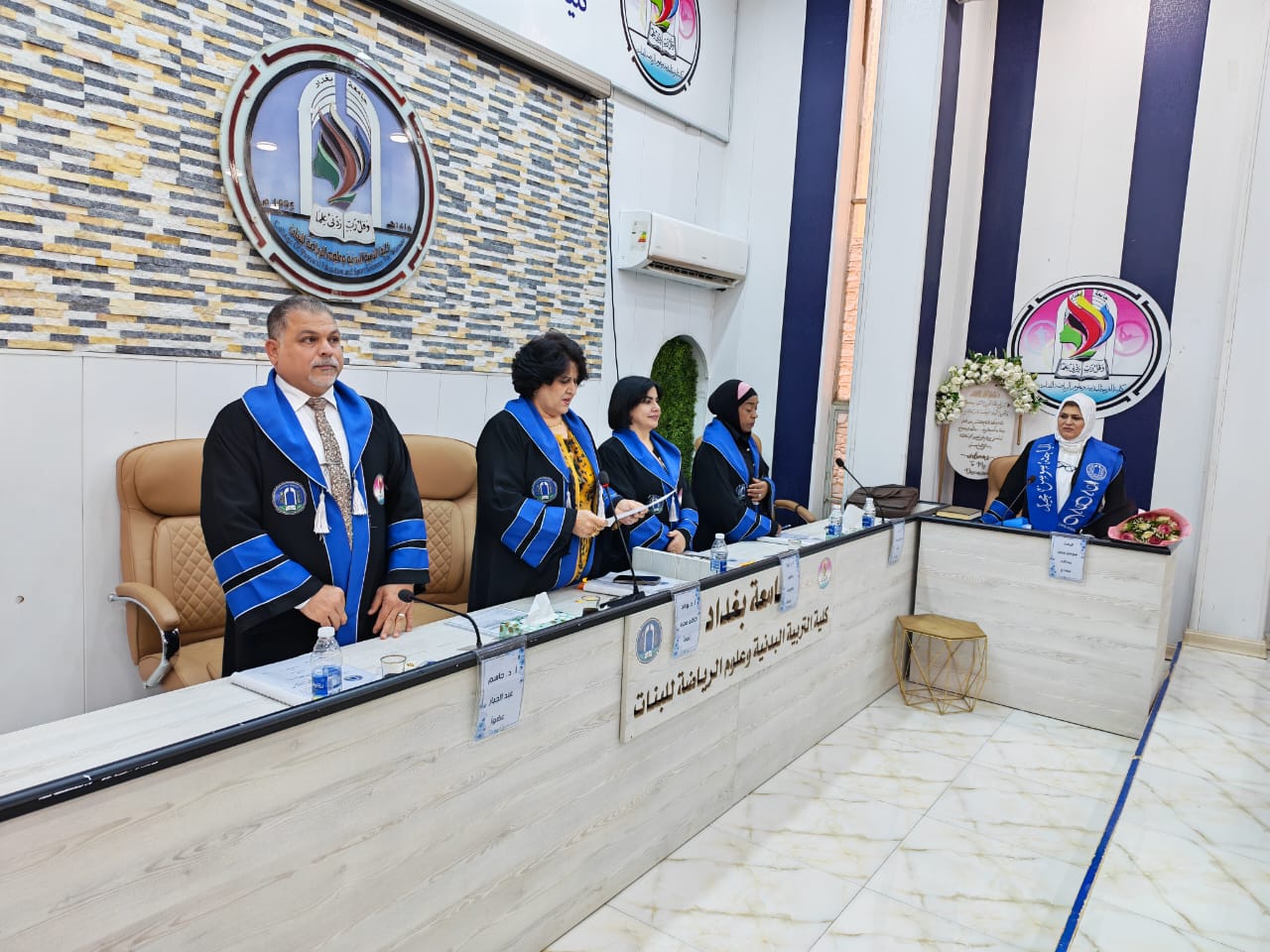
A master’s thesis titled (The Effect of Coordination Training with Visual Occlusion on Some Motor Abilities and the Performance of Offensive Formations for Handball Girls Aged 15-17 Years), by the researcher (Sawsan Majid Abdullah Mehdi), was defended at the College of Physical Education and Sports Sciences for Girls, University of Baghdad.
The defense committee consisted of Prof. Dr. Widad Kazem Majid from the University of Baghdad as Chair, Prof. Dr. Hasim Abdul-Jabbar Saleh from the University of Karbala as an External Member, Prof. Dr. Liza Rustam Yaqoub as Member, and Asst. Prof. Dr. Intidhar Jumaa Mubarak as Supervisor.
The study aimed to prepare coordination training with visual occlusion for handball girls aged 15-17 years, and to identify the effect of coordination training with visual occlusion on some motor abilities and the performance of offensive formations among the two research groups.
The results of the study showed that the tools used possessed an acceptable degree of validity, reliability, and objectivity, which enhances confidence in the derived results. Two pilot experiments were conducted, and the coordination training with visual occlusion was applied for a period of 8 weeks at a rate of three training units per week, bringing the total number of units to 24 units, with a duration of 120 minutes per unit, of which 20-25 minutes were allocated for coordination training with visual occlusion within the main part. The training intensity ranged between 60%-85% using low and high-intensity interval training methods and repetitive training, at a rate of 3 training units per week, taking into account the gradual progression of the load in proportion to the characteristics of the sample. Post-tests were conducted, and data were collected and statistically processed using the SPSS system. The researcher reached the following conclusions: that the adoption of coordination training with visual occlusion contributed clearly and effectively to developing and improving most of the motor abilities and offensive formations under study, which indicates the effectiveness of coordination training with visual occlusion in improving the level of motor and tactical performance. The researcher recommended the necessity of adopting this type of training within training programs for similar age groups, as well as conducting similar studies on different age stages and other skill and tactical variables, to deepen the scientific understanding of the mechanisms of training effects under conditions of reduced visual inputs.
This study achieves the fourth goal of the sustainable development goals represent
A master’s thesis titled (The Effect of Coordination Training with Visual Occlusion on Some Motor Abilities and the Performance of Offensive Formations for Handball Girls Aged 15-17 Years), by the researcher (Sawsan Majid Abdullah Mehdi), was defended at the College of Physical Education and Sports Sciences for Girls, University of Baghdad.
The defense committee consisted of Prof. Dr. Widad Kazem Majid from the University of Baghdad as Chair, Prof. Dr. Hasim Abdul-Jabbar Saleh from the University of Karbala as an External Member, Prof. Dr. Liza Rustam Yaqoub as Member, and Asst. Prof. Dr. Intidhar Jumaa Mubarak as Supervisor.
The study aimed to prepare coordination training with visual occlusion for handball girls aged 15-17 years, and to identify the effect of coordination training with visual occlusion on some motor abilities and the performance of offensive formations among the two research groups.
The results of the study showed that the tools used possessed an acceptable degree of validity, reliability, and objectivity, which enhances confidence in the derived results. Two pilot experiments were conducted, and the coordination training with visual occlusion was applied for a period of 8 weeks at a rate of three training units per week, bringing the total number of units to 24 units, with a duration of 120 minutes per unit, of which 20-25 minutes were allocated for coordination training with visual occlusion within the main part. The training intensity ranged between 60%-85% using low and high-intensity interval training methods and repetitive training, at a rate of 3 training units per week, taking into account the gradual progression of the load in proportion to the characteristics of the sample. Post-tests were conducted, and data were collected and statistically processed using the SPSS system. The researcher reached the following conclusions: that the adoption of coordination training with visual occlusion contributed clearly and effectively to developing and improving most of the motor abilities and offensive formations under study, which indicates the effectiveness of coordination training with visual occlusion in improving the level of motor and tactical performance. The researcher recommended the necessity of adopting this type of training within training programs for similar age groups, as well as conducting similar studies on different age stages and other skill and tactical variables, to deepen the scientific understanding of the mechanisms of training effects under conditions of reduced visual inputs.
This study achieves the fourth goal of the sustainable development goals represent