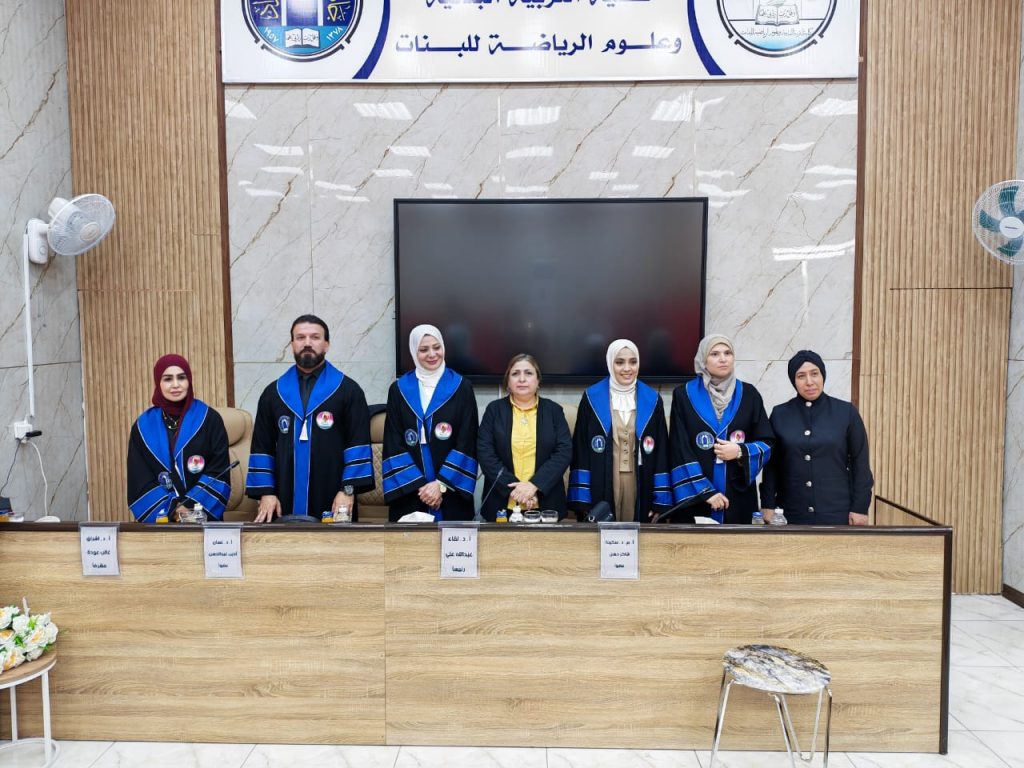
The College of Physical Education and Sports Sciences for Girls, University of Baghdad, witnessed the discussion of the master’s thesis titled (The Effect of Exercises Using the High-Intensity Interval Training Method on the Most Important Physical Abilities, Functional Variables, and Offensive-Defensive Performance for Youth Épée Fencers), by the researcher (Baraa Wisam Khalil). The defense committee consisted of Prof. Dr. Liqaa Abdullah Ali as Chair, Prof. Dr. Ishraq Ghalib Oudah as Supervisor, Prof. Dr. Ghassan Adeeb Abdul-Hassan as an External Member from the University of Baghdad, and Asst. Prof. Dr. Sukaina Shakir Hassan as an External Member from Mustansiriya University.
The study aimed to prepare exercises using the high-intensity interval training method for youth épée fencers, identify the most important physical abilities, functional variables, and offensive-defensive performance among fencers, and identify the effect of exercises using the high-intensity interval training method on the most important physical abilities, functional variables, and offensive-defensive performance among youth players of the Iraqi national team.
The results of the study showed that the application of high-intensity interval training (HIIT) led to a significant improvement in the physical abilities of the épée fencers (speed-strength, muscular endurance, and transitional speed). This was accompanied by a functional development in heart pulse efficiency and maximal oxygen consumption ($VO_2max$), which reflected positively on the accuracy and speed of performing offensive and defensive skills as a result of enhancing neuromuscular coordination.
The researcher recommends generalizing the high-intensity interval training (HIIT) method to the remaining fencing weapons (foil and sabre), focusing on the precise balance between short rest periods and high intensity to develop muscular endurance, emphasizing the integration of diverse skill exercises (offensive and defensive) to enhance neuromuscular coordination, and including functional indicators such as (heart pulse and $VO_2max$) in training programs to elevate performance efficiency, in addition to the necessity of conducting similar research targeting categories and national teams of girls.
Thus, this study and its discussion contribute to achieving the fourth goal of the sustainable development goals, which is (Quality Education), through developing the quality of sports training and educational curricula.
The College of Physical Education and Sports Sciences for Girls, University of Baghdad, witnessed the discussion of the master’s thesis titled (The Effect of Exercises Using the High-Intensity Interval Training Method on the Most Important Physical Abilities, Functional Variables, and Offensive-Defensive Performance for Youth Épée Fencers), by the researcher (Baraa Wisam Khalil). The defense committee consisted of Prof. Dr. Liqaa Abdullah Ali as Chair, Prof. Dr. Ishraq Ghalib Oudah as Supervisor, Prof. Dr. Ghassan Adeeb Abdul-Hassan as an External Member from the University of Baghdad, and Asst. Prof. Dr. Sukaina Shakir Hassan as an External Member from Mustansiriya University.
The study aimed to prepare exercises using the high-intensity interval training method for youth épée fencers, identify the most important physical abilities, functional variables, and offensive-defensive performance among fencers, and identify the effect of exercises using the high-intensity interval training method on the most important physical abilities, functional variables, and offensive-defensive performance among youth players of the Iraqi national team.
The results of the study showed that the application of high-intensity interval training (HIIT) led to a significant improvement in the physical abilities of the épée fencers (speed-strength, muscular endurance, and transitional speed). This was accompanied by a functional development in heart pulse efficiency and maximal oxygen consumption ($VO_2max$), which reflected positively on the accuracy and speed of performing offensive and defensive skills as a result of enhancing neuromuscular coordination.
The researcher recommends generalizing the high-intensity interval training (HIIT) method to the remaining fencing weapons (foil and sabre), focusing on the precise balance between short rest periods and high intensity to develop muscular endurance, emphasizing the integration of diverse skill exercises (offensive and defensive) to enhance neuromuscular coordination, and including functional indicators such as (heart pulse and $VO_2max$) in training programs to elevate performance efficiency, in addition to the necessity of conducting similar research targeting categories and national teams of girls.
Thus, this study and its discussion contribute to achieving the fourth goal of the sustainable development goals, which is (Quality Education), through developing the quality of sports training and educational curricula.