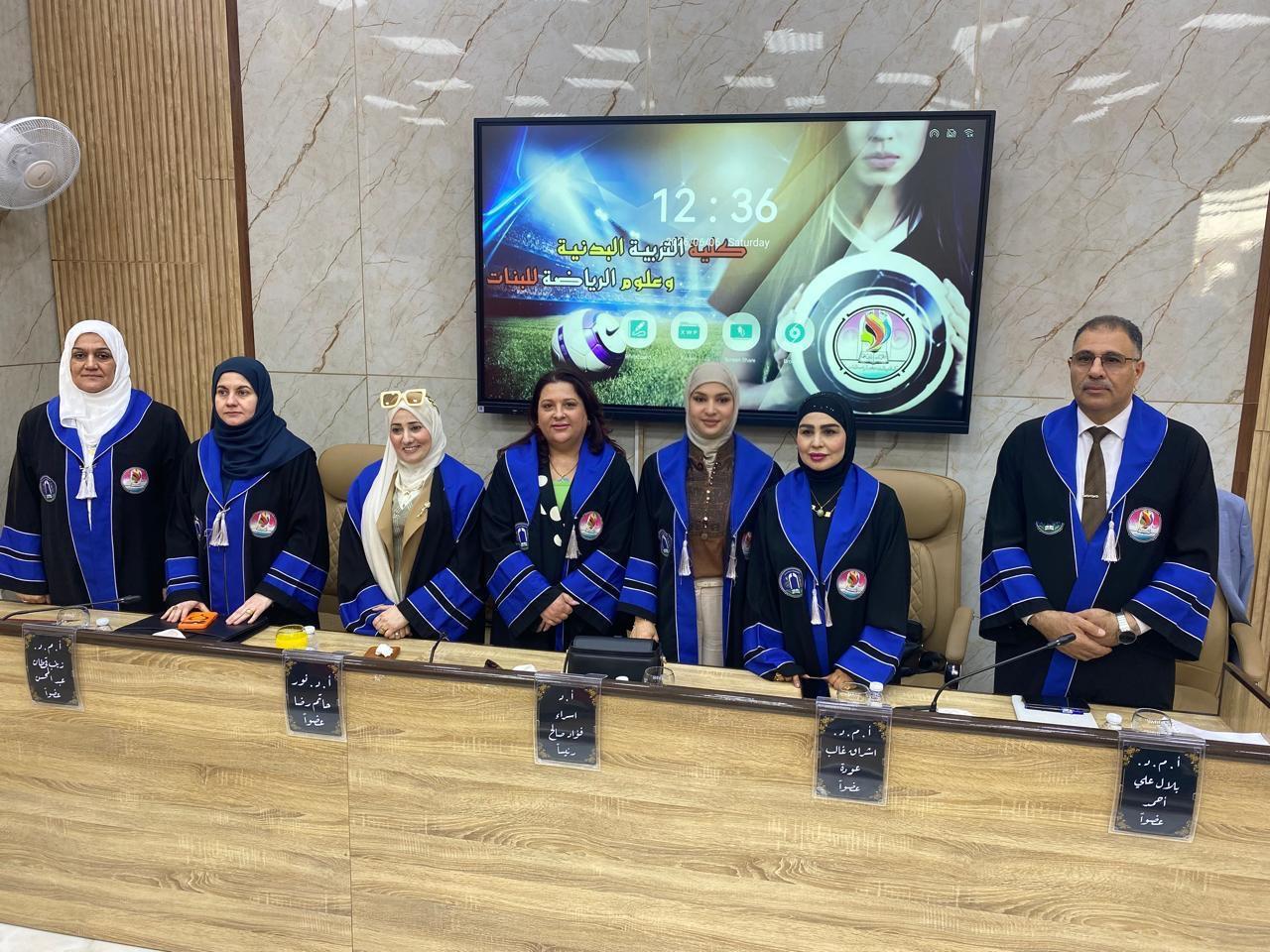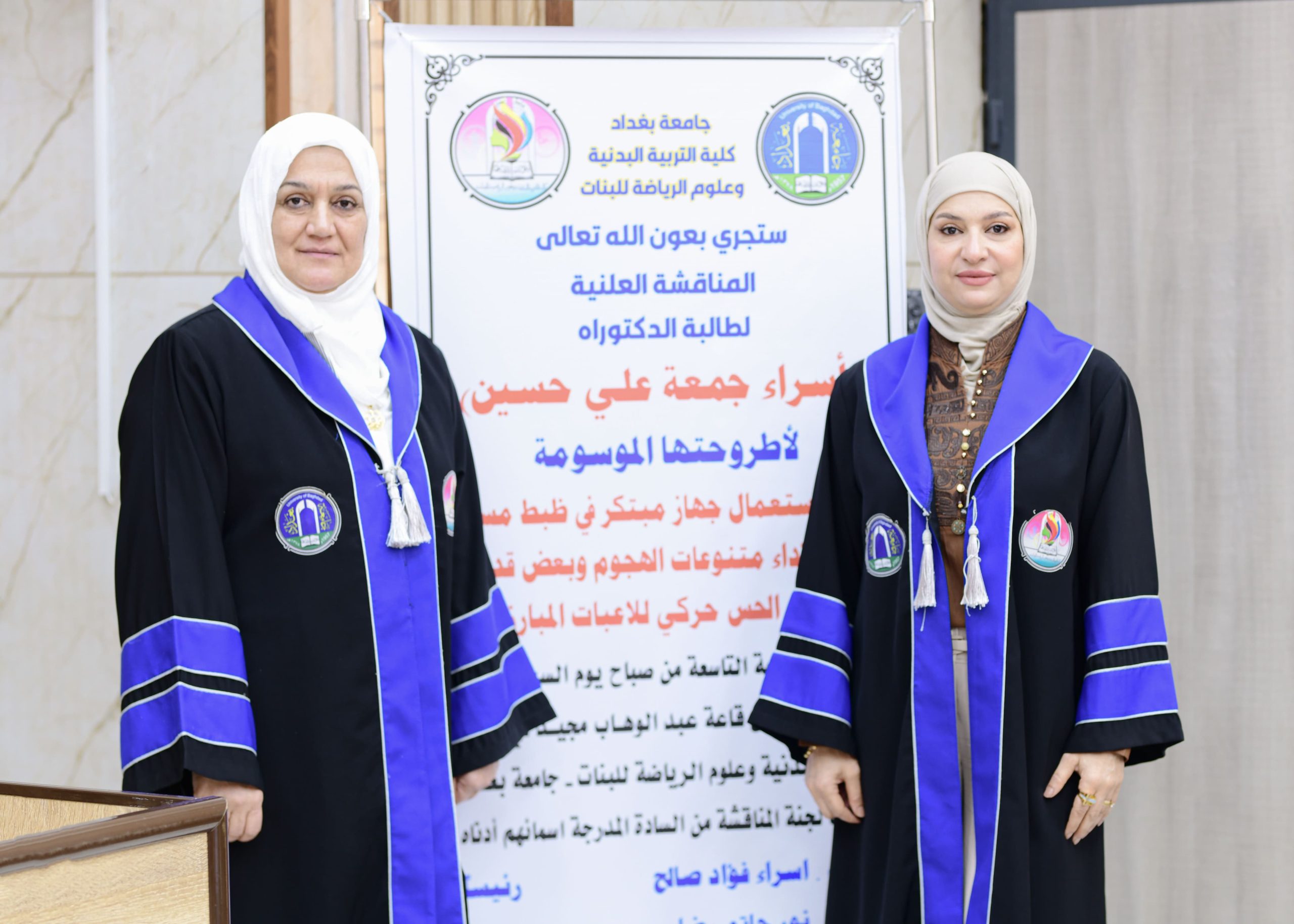

The Dean of the College of Physical Education and Sports Sciences for Girls, University of Baghdad, Professor Dr. Fatima Abid Maleh, supervised the doctoral dissertation defense of the student (Israa Jumaah Ali Hussein), titled (The Effect of Using an Innovative Smart Sensor Device on Regulating Fencing Distance and Selected Kinesthetic Perception Abilities for Executing Attack Variations Among Female Foil Fencers). The examination committee comprised Professor Dr. Israa Fuad Salih as Chair, along with Professor Dr. Noor Hatim Rida, Assistant Professor Dr. Ishraq Ghalib Oudah, Assistant Professor Dr. Zainab Qahtan Abdul Muhsin, and Assistant Professor Dr. Bilal Ali Ahmed (External Member from Ibn Sina University).
The study aimed to achieve a qualitative shift in sports training by designing and manufacturing an innovative device that ensures high-precision regulation of fencing distance. Additionally, it sought to investigate the scientific differences between the pre- and post-tests for both the experimental and control groups, reveal the development of the fencers’ skills in executing attack variations and kinesthetic perception abilities, and conduct a precise post-test comparison between the two groups to determine the extent of benefit gained from this technological innovation.
The results demonstrated that the smart sensor device, equipped with a visual and auditory alarm system, exhibited advanced efficiency in elevating the performance level of the experimental group and developing their ability to regulate tactical fencing distance. The exercises supported by this device enhanced kinesthetic perception by providing immediate, real-time feedback. Furthermore, integrating attack variation exercises with the new technology generated a positive leap in the fencers’ technical performance, whereas the control group recorded limited improvement relying on traditional exercises, confirming the superiority of training enhanced by artificial intelligence and modern technology.
The study reached a set of recommendations, including: the necessity of investing in artificial intelligence technologies to optimize effort and time, minimizing training waste through the use of smart measurement tools that increase athlete motivation, and ensuring the regular integration of the sensor and auditory-visual alarm system into training curricula. The study also urged coaches to design specialized exercises that consider the physical measurements of each fencer to guarantee tactical accuracy and skill performance, utilize contemporary educational aids to reduce errors, and focus on training that stimulates the neurological response system and instantaneous perception of timing and distance.
This scientific and academic achievement directly aligns with international efforts to achieve the Sustainable Development Goals (SDGs), specifically the fourth goal, Quality Education. This discussion reflects the success of educational institutions in employing digital innovation and artificial intelligence to enhance the quality of education and training, thereby elevating academic and athletic outcomes.
The Dean of the College of Physical Education and Sports Sciences for Girls, University of Baghdad, Professor Dr. Fatima Abid Maleh, supervised the doctoral dissertation defense of the student (Israa Jumaah Ali Hussein), titled (The Effect of Using an Innovative Smart Sensor Device on Regulating Fencing Distance and Selected Kinesthetic Perception Abilities for Executing Attack Variations Among Female Foil Fencers). The examination committee comprised Professor Dr. Israa Fuad Salih as Chair, along with Professor Dr. Noor Hatim Rida, Assistant Professor Dr. Ishraq Ghalib Oudah, Assistant Professor Dr. Zainab Qahtan Abdul Muhsin, and Assistant Professor Dr. Bilal Ali Ahmed (External Member from Ibn Sina University).
The study aimed to achieve a qualitative shift in sports training by designing and manufacturing an innovative device that ensures high-precision regulation of fencing distance. Additionally, it sought to investigate the scientific differences between the pre- and post-tests for both the experimental and control groups, reveal the development of the fencers’ skills in executing attack variations and kinesthetic perception abilities, and conduct a precise post-test comparison between the two groups to determine the extent of benefit gained from this technological innovation.
The results demonstrated that the smart sensor device, equipped with a visual and auditory alarm system, exhibited advanced efficiency in elevating the performance level of the experimental group and developing their ability to regulate tactical fencing distance. The exercises supported by this device enhanced kinesthetic perception by providing immediate, real-time feedback. Furthermore, integrating attack variation exercises with the new technology generated a positive leap in the fencers’ technical performance, whereas the control group recorded limited improvement relying on traditional exercises, confirming the superiority of training enhanced by artificial intelligence and modern technology.
The study reached a set of recommendations, including: the necessity of investing in artificial intelligence technologies to optimize effort and time, minimizing training waste through the use of smart measurement tools that increase athlete motivation, and ensuring the regular integration of the sensor and auditory-visual alarm system into training curricula. The study also urged coaches to design specialized exercises that consider the physical measurements of each fencer to guarantee tactical accuracy and skill performance, utilize contemporary educational aids to reduce errors, and focus on training that stimulates the neurological response system and instantaneous perception of timing and distance.
This scientific and academic achievement directly aligns with international efforts to achieve the Sustainable Development Goals (SDGs), specifically the fourth goal, Quality Education. This discussion reflects the success of educational institutions in employing digital innovation and artificial intelligence to enhance the quality of education and training, thereby elevating academic and athletic outcomes.