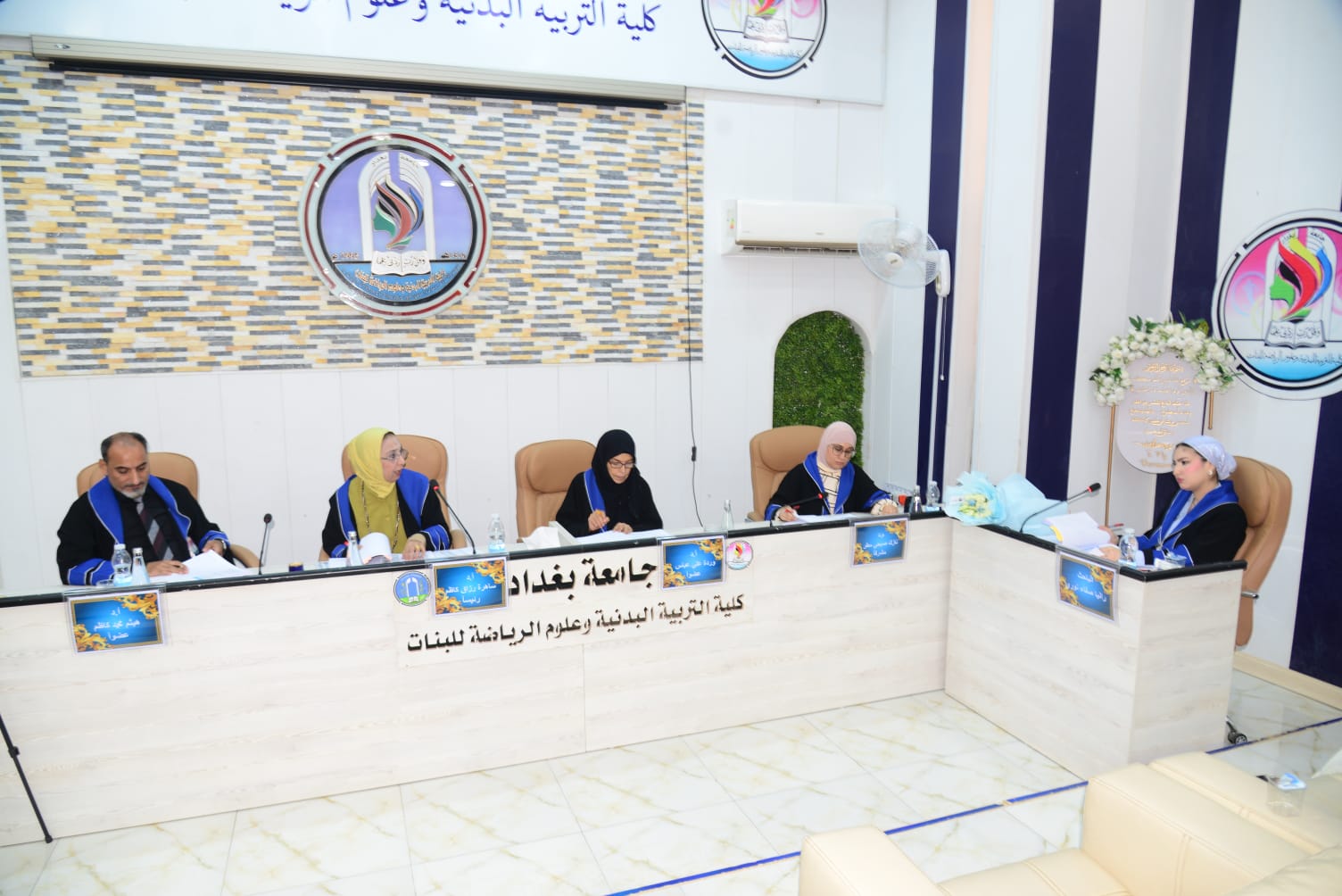
The Master’s thesis entitled (“A Mental Psychological Program Using Information Technology to Reduce Psychological Hesitation and Its Effect on the Effectiveness of Serve Skill Performance in Tennis for Youth Category”), presented by the researcher (Rania Safaa Nouri), was discussed at the College of Physical Education and Sports Sciences for Girls / University of Baghdad.
The examination committee consisted of Prof. Dr. Sahira Razzaq Kazim as Chairman, Prof. Dr. Haitham Muhammad Kazim from the University of Babylon as an external member, Prof. Dr. Warda Ali Abbas as a member, and Assist. Prof. Dr. Nazik Subhi Matar as a member and supervisor.
The study aimed to prepare a psychological hesitation scale for tennis players aged (17-20) years for the year (2025-2026), prepare a mental psychological program relying on information technology to reduce their psychological hesitation, identify the level of psychological hesitation and the level of serve skill performance among players when applying the program, as well as identify the effectiveness of the program in reducing psychological hesitation and its effect on improving the effectiveness of serve skill performance among youth tennis players. This was carried out through applying the experiment to a sample of tennis players from Al-Jadriya Tennis Academy (males) aged (17-20) years for the season (2025-2026), at the court of Al-Jadriya Tennis Academy / Al-Nahrain University.
The results showed that the mental psychological program supported by virtual reality technology was effective in reducing psychological hesitation and increasing the efficiency of serve skill performance. Technology contributed to enhancing mental imagery, raising levels of concentration and self-confidence, and improving the precision of understanding the technical performance stages. It also created an interactive environment simulating real competition conditions, which increased excitement, motivation, and cooperation among players. The prepared scale proved its scientific effectiveness in measuring the effects of these variables.
The study recommends adopting this scale and mental psychological program in sports academies and centers. It also recommends using tools such as presentations and virtual reality technology within educational units due to their effective role in reducing psychological hesitation and improving serve performance among tennis players of various ages.
This discussion contributes to achieving one of the Sustainable Development Goals, which is Goal 4: Quality Education.
The Master’s thesis entitled (“A Mental Psychological Program Using Information Technology to Reduce Psychological Hesitation and Its Effect on the Effectiveness of Serve Skill Performance in Tennis for Youth Category”), presented by the researcher (Rania Safaa Nouri), was discussed at the College of Physical Education and Sports Sciences for Girls / University of Baghdad.
The examination committee consisted of Prof. Dr. Sahira Razzaq Kazim as Chairman, Prof. Dr. Haitham Muhammad Kazim from the University of Babylon as an external member, Prof. Dr. Warda Ali Abbas as a member, and Assist. Prof. Dr. Nazik Subhi Matar as a member and supervisor.
The study aimed to prepare a psychological hesitation scale for tennis players aged (17-20) years for the year (2025-2026), prepare a mental psychological program relying on information technology to reduce their psychological hesitation, identify the level of psychological hesitation and the level of serve skill performance among players when applying the program, as well as identify the effectiveness of the program in reducing psychological hesitation and its effect on improving the effectiveness of serve skill performance among youth tennis players. This was carried out through applying the experiment to a sample of tennis players from Al-Jadriya Tennis Academy (males) aged (17-20) years for the season (2025-2026), at the court of Al-Jadriya Tennis Academy / Al-Nahrain University.
The results showed that the mental psychological program supported by virtual reality technology was effective in reducing psychological hesitation and increasing the efficiency of serve skill performance. Technology contributed to enhancing mental imagery, raising levels of concentration and self-confidence, and improving the precision of understanding the technical performance stages. It also created an interactive environment simulating real competition conditions, which increased excitement, motivation, and cooperation among players. The prepared scale proved its scientific effectiveness in measuring the effects of these variables.
The study recommends adopting this scale and mental psychological program in sports academies and centers. It also recommends using tools such as presentations and virtual reality technology within educational units due to their effective role in reducing psychological hesitation and improving serve performance among tennis players of various ages.
This discussion contributes to achieving one of the Sustainable Development Goals, which is Goal 4: Quality Education.