
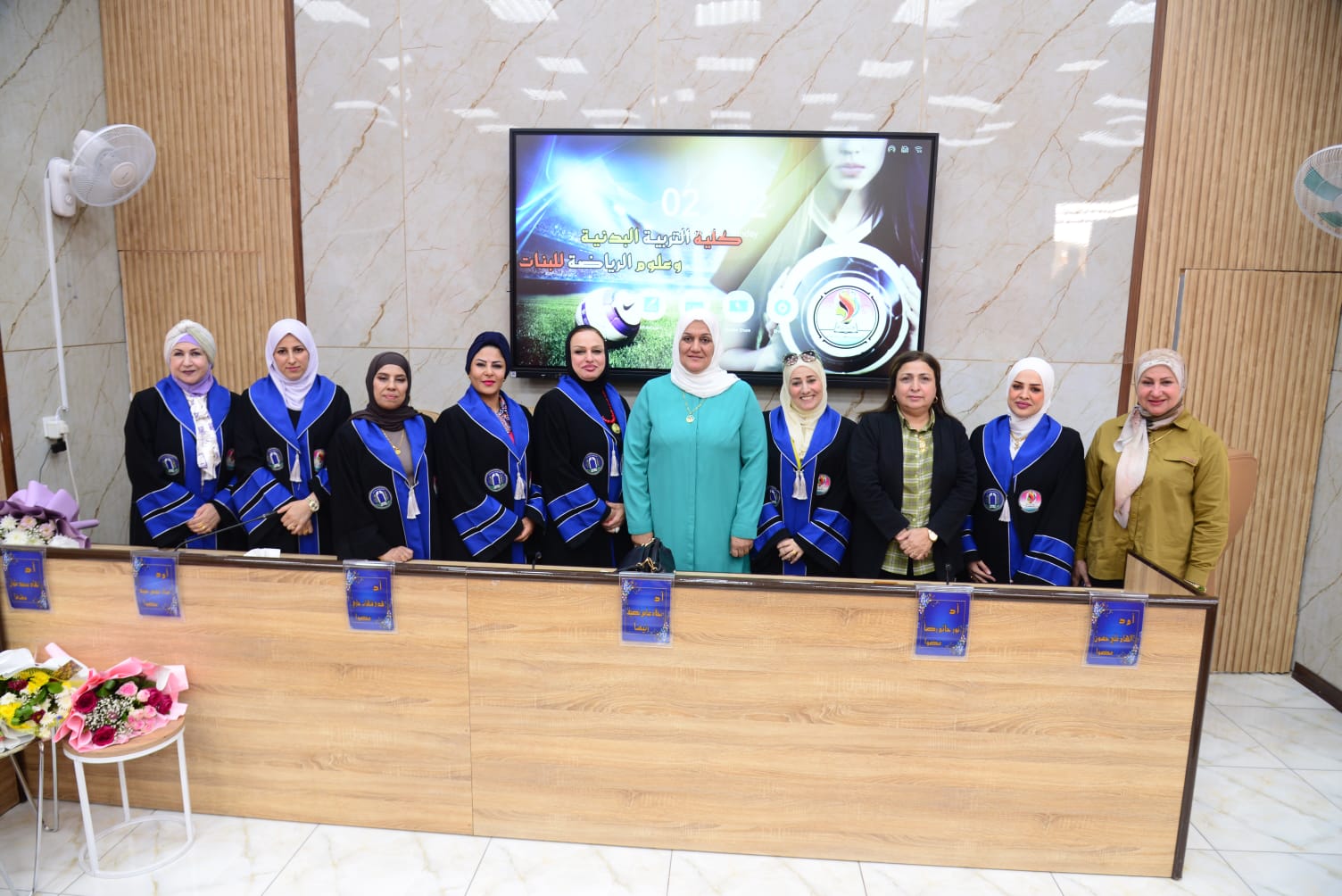
The defense committee consisted of Prof. Dr. Najlaa Abbas Naseef (Chair), Prof. Dr. Huda Shehab Jari (Member), Prof. Dr. Noor Hatem Reza (Member), Assoc. Prof. Dr. Sanaa Khamis Hameed (Member), Assoc. Prof. Dr. Ilham Ali Hassoun from Al-Mustansiriyah University (External Member), and Prof. Dr. Nihad Muhammad Alwan (Supervisor).
The study aimed to develop a dedicated scale for cognitive agility for third-year female college students; design educational modules based on the Pentagram strategy to enhance cognitive agility and improve performance in movement sequences using the hoop apparatus in rhythmic gymnastics; and identify the impact of these educational modules on improving both cognitive agility and skill performance in movement sequences among the research sample.
The results demonstrated that the Pentagram strategy achieved statistically significant improvements in cognitive agility, clearly outperforming the traditional approach across all measurement indicators. It also noticeably contributed to improving movement sequence skills using the hoop, as well as fostering cognitive flexibility, cognitive openness, and attention concentration.
The study recommended adopting the Pentagram strategy in teaching hoop skills within the rhythmic gymnastics curriculum, utilizing modern strategies based on active learning in practical classes, and emphasizing the development of cognitive agility as a core variable directly linked to the quality of skill performance.
This dissertation defense aligns with Goal 4 of the Sustainable Development Goals (Quality Education) by employing an innovative teaching strategy that contributes to curriculum development, improves educational outcomes, and enhances the quality of academic and pedagogical performance in the field of physical education.
The defense committee consisted of Prof. Dr. Najlaa Abbas Naseef (Chair), Prof. Dr. Huda Shehab Jari (Member), Prof. Dr. Noor Hatem Reza (Member), Assoc. Prof. Dr. Sanaa Khamis Hameed (Member), Assoc. Prof. Dr. Ilham Ali Hassoun from Al-Mustansiriyah University (External Member), and Prof. Dr. Nihad Muhammad Alwan (Supervisor).
The study aimed to develop a dedicated scale for cognitive agility for third-year female college students; design educational modules based on the Pentagram strategy to enhance cognitive agility and improve performance in movement sequences using the hoop apparatus in rhythmic gymnastics; and identify the impact of these educational modules on improving both cognitive agility and skill performance in movement sequences among the research sample.
The results demonstrated that the Pentagram strategy achieved statistically significant improvements in cognitive agility, clearly outperforming the traditional approach across all measurement indicators. It also noticeably contributed to improving movement sequence skills using the hoop, as well as fostering cognitive flexibility, cognitive openness, and attention concentration.
The study recommended adopting the Pentagram strategy in teaching hoop skills within the rhythmic gymnastics curriculum, utilizing modern strategies based on active learning in practical classes, and emphasizing the development of cognitive agility as a core variable directly linked to the quality of skill performance.
This dissertation defense aligns with Goal 4 of the Sustainable Development Goals (Quality Education) by employing an innovative teaching strategy that contributes to curriculum development, improves educational outcomes, and enhances the quality of academic and pedagogical performance in the field of physical education.


