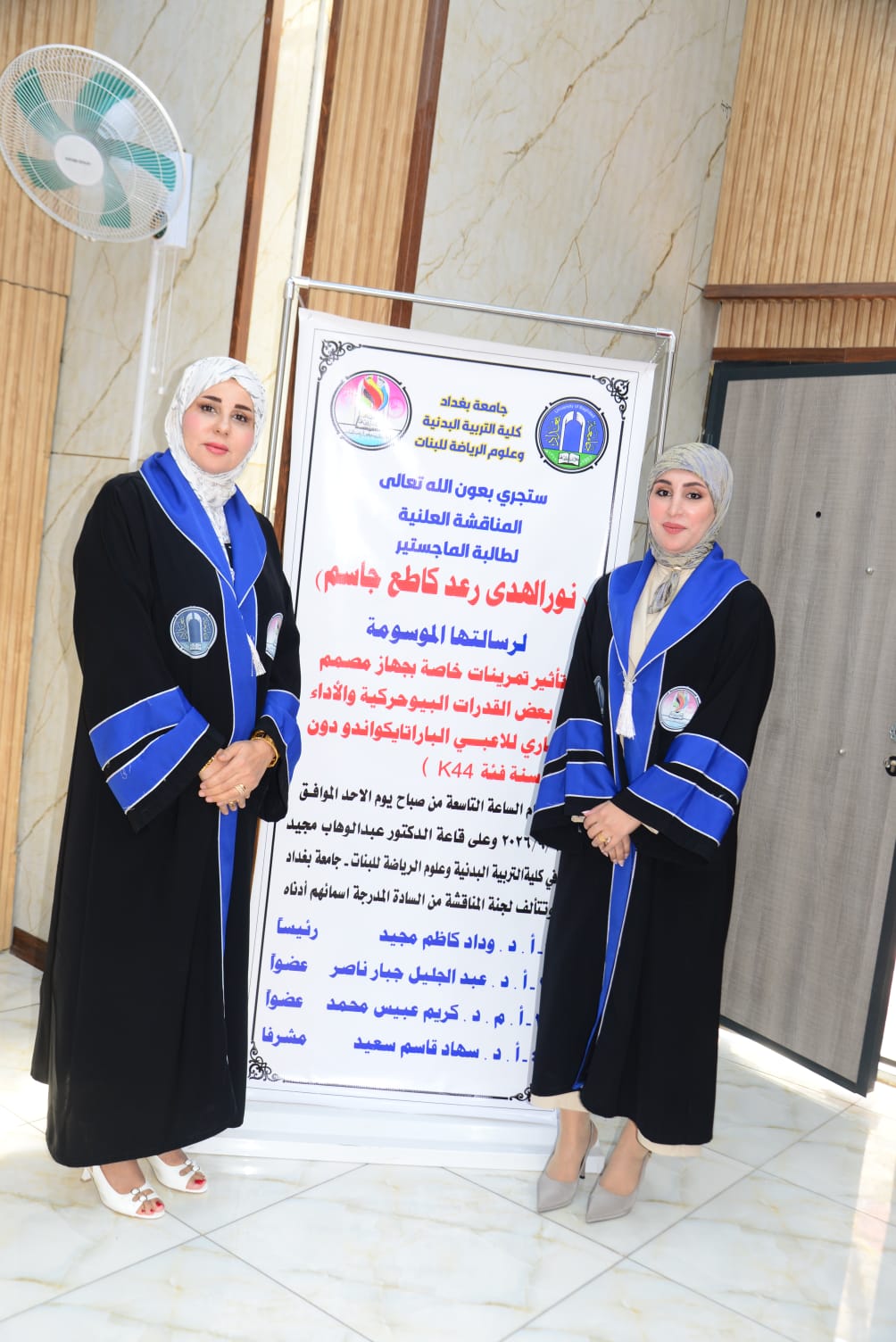
A Master’s thesis titled (“The Effect of Special Exercises Using a Designed Device on Select Biomotor Abilities and Skill Performance in Para-Taekwondo Athletes Under 17 Years (Class K44)”) by the researcher (Noor Al-Huda Raad Katea) was defended at the College of Physical Education and Sports Sciences for Girls.
The examination committee comprised Prof. Dr. Widad Kazim Majeed (University of Baghdad) as Chair, Prof. Dr. Abdul-Jaleel Jabbar Nasir (University of Baghdad) as Member, Assoc. Prof. Dr. Kareem Obeis Mohammad (Al-Mustansiriyah University) as External Member, and Prof. Dr. Suhad Qasim Saeed as Member and Supervisor.
The study aimed to design an electronic device to enhance the biomotor abilities and skill performance of Para-Taekwondo athletes, in addition to developing specialized exercises targeting Para-Taekwondo players under the age of 17.
The researcher concluded that the custom-designed training device positively affected all evaluated variables, noting that the integrated audio-visual rhythm regulation system provided high precision in managing training load components. Furthermore, implementing the specialized exercises via the device alongside progressive overload and resistance principles significantly improved biomotor capabilities.
The researcher recommended adopting the designed training device as a primary tool for biomotor conditioning in Para-Taekwondo athletes under 17 years, incorporating it into the official training curricula of Iraqi national Para-Taekwondo teams, expanding its deployment across regional training centers and clubs, and directly integrating device-based drills with core Para-Taekwondo execution skills, specifically offensive and counter-offensive kicks.
This thesis defense directly supports the implementation of the Sustainable Development Goals, specifically Goal 4: Quality Education (SDG 4).
A Master’s thesis titled (“The Effect of Special Exercises Using a Designed Device on Select Biomotor Abilities and Skill Performance in Para-Taekwondo Athletes Under 17 Years (Class K44)”) by the researcher (Noor Al-Huda Raad Katea) was defended at the College of Physical Education and Sports Sciences for Girls.
The examination committee comprised Prof. Dr. Widad Kazim Majeed (University of Baghdad) as Chair, Prof. Dr. Abdul-Jaleel Jabbar Nasir (University of Baghdad) as Member, Assoc. Prof. Dr. Kareem Obeis Mohammad (Al-Mustansiriyah University) as External Member, and Prof. Dr. Suhad Qasim Saeed as Member and Supervisor.
The study aimed to design an electronic device to enhance the biomotor abilities and skill performance of Para-Taekwondo athletes, in addition to developing specialized exercises targeting Para-Taekwondo players under the age of 17.
The researcher concluded that the custom-designed training device positively affected all evaluated variables, noting that the integrated audio-visual rhythm regulation system provided high precision in managing training load components. Furthermore, implementing the specialized exercises via the device alongside progressive overload and resistance principles significantly improved biomotor capabilities.
The researcher recommended adopting the designed training device as a primary tool for biomotor conditioning in Para-Taekwondo athletes under 17 years, incorporating it into the official training curricula of Iraqi national Para-Taekwondo teams, expanding its deployment across regional training centers and clubs, and directly integrating device-based drills with core Para-Taekwondo execution skills, specifically offensive and counter-offensive kicks.
This thesis defense directly supports the implementation of the Sustainable Development Goals, specifically Goal 4: Quality Education (SDG 4).