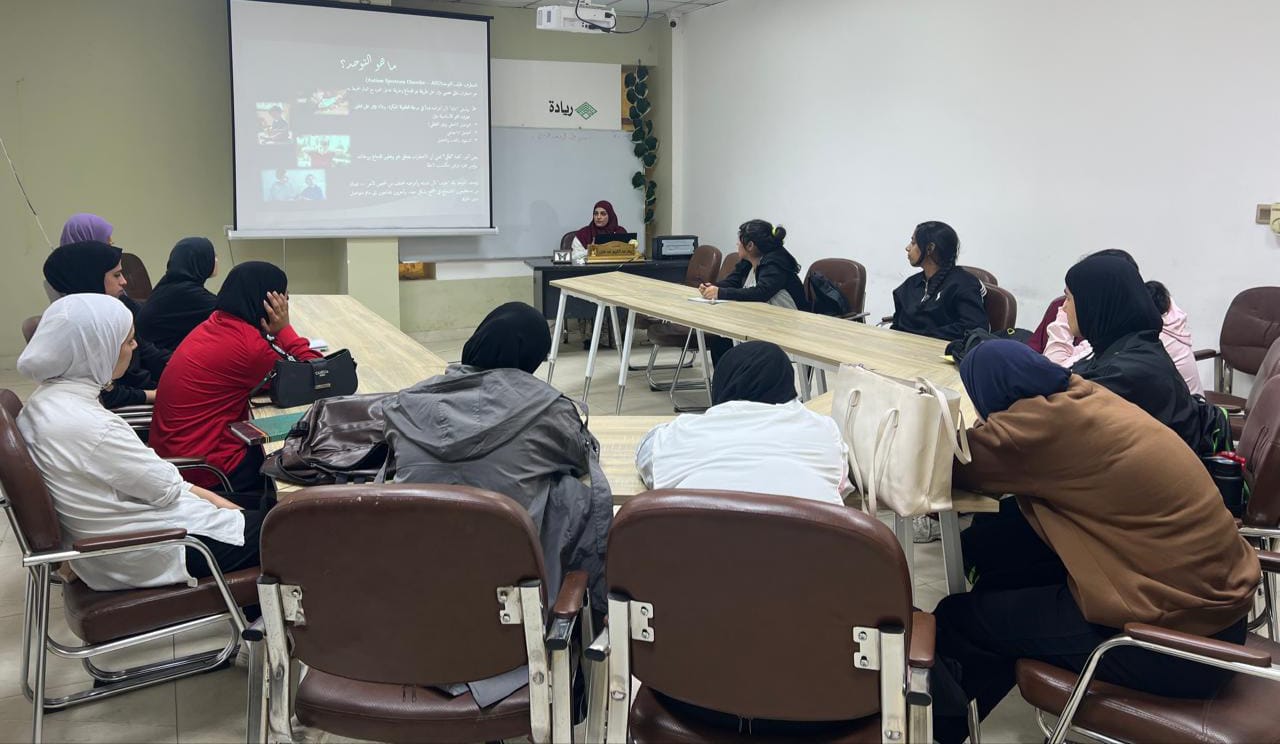
The Rehabilitation and Employment Unit at the College of Physical Education and Sports Sciences for Women / University of Baghdad held a scientific workshop titled )Autism: A Widespread Epidemic(, delivered by the lecturer Asst. Lect. Farah Laith Naji.
The workshop aimed to introduce autism, explore its possible causes, identify its symptoms, highlight available treatment approaches, and discuss the reasons behind its rapid increase.
The presenter defined autism as a neurodevelopmental disorder that affects brain development and the way an individual interacts with the surrounding world, with symptoms typically appearing in early childhood. She pointed out several possible causes, including:
Genetic and hereditary factors, neurological and biological factors, environmental factors, and immune-related factors.
She also explained the most important symptoms of autism, such as:
-
weak social communication,
-
verbal and non-verbal communication difficulties,
-
repetitive and stereotypical behaviors.
She further noted that the rapid rise in autism diagnoses is linked to increased parental awareness, the use of more accurate diagnostic tools, the expansion of the autism spectrum to include milder forms that previously went unnoticed, and modern environmental factors such as stress and fast-paced lifestyles.
The lecturer emphasized that there is still no definitive cure for autism; however, multidisciplinary therapeutic programs can significantly improve the condition. These include behavioral therapy to teach daily-life skills, speech and language therapy, occupational therapy, medication-based treatment, and the application of school inclusion programs.
In conclusion, she highlighted the crucial role of parents in dealing with autism through early observation, timely therapeutic intervention, adherence to treatment plans, collaboration with specialists, encouraging the child to express themselves, and avoiding isolation. She also emphasized the role of society in promoting a culture of acceptance and inclusion rather than stigma, training educational and medical staff on appropriate strategies, launching awareness campaigns, and establishing early-diagnosis centers.
This workshop contributes to two Sustainable Development Goals: Goal 3 Good Health and Well-being), and Goal 4 (Quality Education).
The Rehabilitation and Employment Unit at the College of Physical Education and Sports Sciences for Women / University of Baghdad held a scientific workshop titled )Autism: A Widespread Epidemic(, delivered by the lecturer Asst. Lect. Farah Laith Naji.
The workshop aimed to introduce autism, explore its possible causes, identify its symptoms, highlight available treatment approaches, and discuss the reasons behind its rapid increase.
The presenter defined autism as a neurodevelopmental disorder that affects brain development and the way an individual interacts with the surrounding world, with symptoms typically appearing in early childhood. She pointed out several possible causes, including:
Genetic and hereditary factors, neurological and biological factors, environmental factors, and immune-related factors.
She also explained the most important symptoms of autism, such as:
-
weak social communication,
-
verbal and non-verbal communication difficulties,
-
repetitive and stereotypical behaviors.
She further noted that the rapid rise in autism diagnoses is linked to increased parental awareness, the use of more accurate diagnostic tools, the expansion of the autism spectrum to include milder forms that previously went unnoticed, and modern environmental factors such as stress and fast-paced lifestyles.
The lecturer emphasized that there is still no definitive cure for autism; however, multidisciplinary therapeutic programs can significantly improve the condition. These include behavioral therapy to teach daily-life skills, speech and language therapy, occupational therapy, medication-based treatment, and the application of school inclusion programs.
In conclusion, she highlighted the crucial role of parents in dealing with autism through early observation, timely therapeutic intervention, adherence to treatment plans, collaboration with specialists, encouraging the child to express themselves, and avoiding isolation. She also emphasized the role of society in promoting a culture of acceptance and inclusion rather than stigma, training educational and medical staff on appropriate strategies, launching awareness campaigns, and establishing early-diagnosis centers.
This workshop contributes to two Sustainable Development Goals: Goal 3 Good Health and Well-being), and Goal 4 (Quality Education).