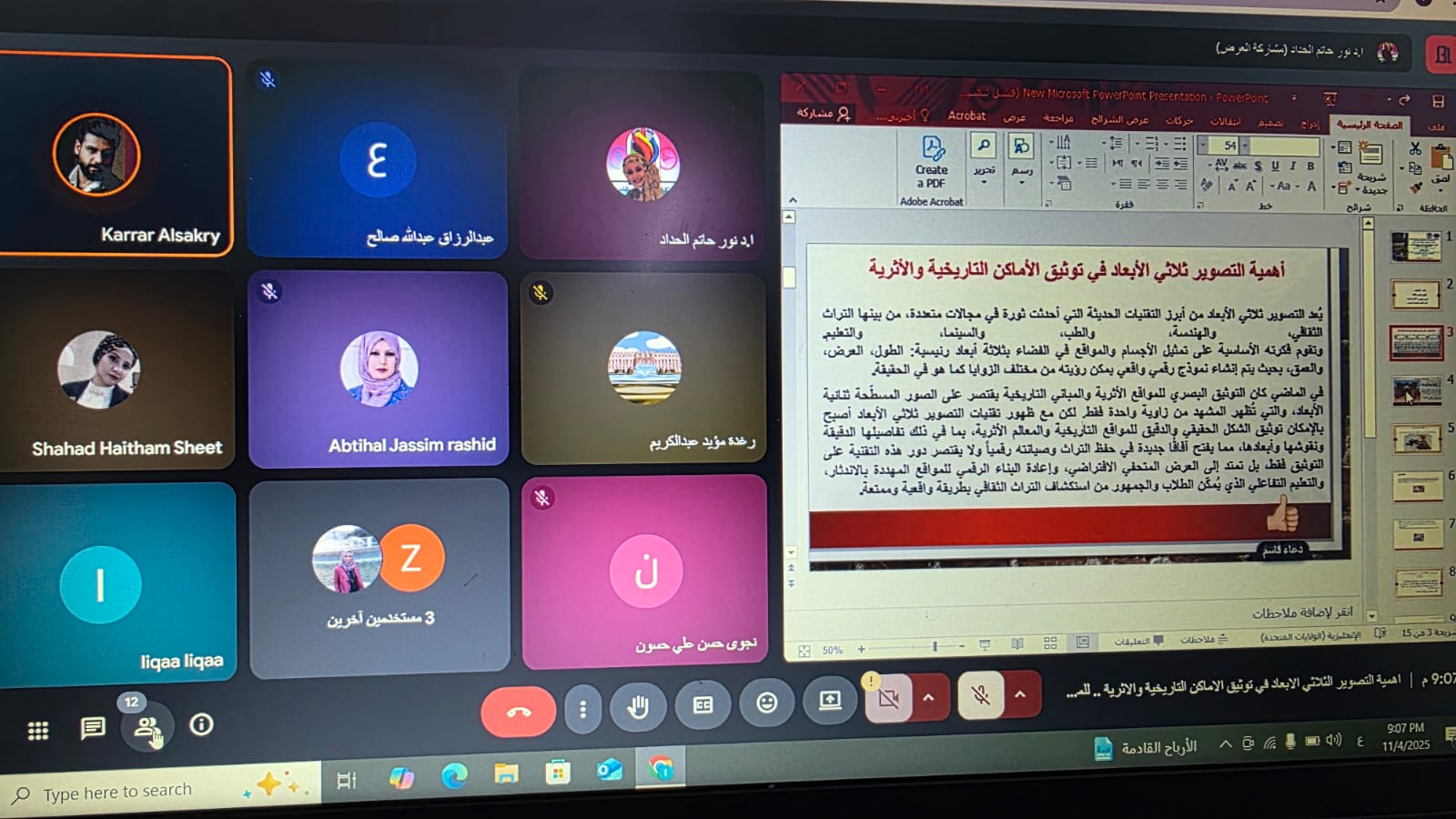
The Ibn Sina E-Learning Unit at the College of Physical Education and Sports Sciences for Women, University of Baghdad, hosted—under the patronage of the Dean, Prof. Dr. Fatima Abd Maleh, and the supervision of Prof. Dr. Noor Hatem Redha—the Asst. Lect. from the Presidency of the University of Baghdad / Department of Media and Government Communication, Karar Haider Hatif, to present an online scientific workshop titled (The Importance of 3D Imaging in Documenting Historical and Archaeological Sites).
The workshop began with an introduction to 3D imaging, defined as the process of representing the shape of an object or site in real space in a digital form that contains three main dimensions: length, width, and depth. This allows the generated model to be viewed from all directions as if it were a real physical object. This type of imaging relies on a set of digital techniques such as photogrammetry and laser scanning.
The presenter highlighted the significance of 3D imaging in documenting historical sites, describing it as one of the most advanced tools in cultural heritage preservation due to its high accuracy and realistic representation capabilities that are difficult to achieve with traditional methods. Its advantages include precise documentation and digital preservation, supporting restoration and maintenance work, facilitating scientific research, documenting endangered or remote sites, and integrating technology with heritage.
He also discussed the growing role of artificial intelligence in heritage documentation, noting its ability to analyze large datasets, enable digital reconstruction, predict deterioration, enhance access to heritage information, provide continuous scientific documentation, and support innovation in digital technologies.
At the conclusion of the workshop, Mr. Karar presented several recommendations, including: encouraging archaeological institutions and museums to adopt 3D imaging and artificial intelligence in documentation processes; creating a unified digital archive for historical sites; promoting collaboration between universities, research centers, and international museums for the exchange of expertise and digital data; and organizing workshops and training programs for researchers and students on photogrammetry, laser scanning, and data analysis using artificial intelligence.
This workshop contributes to two Sustainable Development Goals: Goal 4 (Quality Education) and Goal 17 (Partnerships for the Goals).
The Ibn Sina E-Learning Unit at the College of Physical Education and Sports Sciences for Women, University of Baghdad, hosted—under the patronage of the Dean, Prof. Dr. Fatima Abd Maleh, and the supervision of Prof. Dr. Noor Hatem Redha—the Asst. Lect. from the Presidency of the University of Baghdad / Department of Media and Government Communication, Karar Haider Hatif, to present an online scientific workshop titled (The Importance of 3D Imaging in Documenting Historical and Archaeological Sites).
The workshop began with an introduction to 3D imaging, defined as the process of representing the shape of an object or site in real space in a digital form that contains three main dimensions: length, width, and depth. This allows the generated model to be viewed from all directions as if it were a real physical object. This type of imaging relies on a set of digital techniques such as photogrammetry and laser scanning.
The presenter highlighted the significance of 3D imaging in documenting historical sites, describing it as one of the most advanced tools in cultural heritage preservation due to its high accuracy and realistic representation capabilities that are difficult to achieve with traditional methods. Its advantages include precise documentation and digital preservation, supporting restoration and maintenance work, facilitating scientific research, documenting endangered or remote sites, and integrating technology with heritage.
He also discussed the growing role of artificial intelligence in heritage documentation, noting its ability to analyze large datasets, enable digital reconstruction, predict deterioration, enhance access to heritage information, provide continuous scientific documentation, and support innovation in digital technologies.
At the conclusion of the workshop, Mr. Karar presented several recommendations, including: encouraging archaeological institutions and museums to adopt 3D imaging and artificial intelligence in documentation processes; creating a unified digital archive for historical sites; promoting collaboration between universities, research centers, and international museums for the exchange of expertise and digital data; and organizing workshops and training programs for researchers and students on photogrammetry, laser scanning, and data analysis using artificial intelligence.
This workshop contributes to two Sustainable Development Goals: Goal 4 (Quality Education) and Goal 17 (Partnerships for the Goals).